

This guide will help you get around Nagoya city using the Nagoya Subway. It covers the basics of navigating the subway system and using the IC transport card, MANACA.
First, don’t worry, the Nagoya Subway is much simpler than the subway systems in Tokyo or Osaka and is easy to use, even for first-time visitors.
Your first subway experience will likely start at Nagoya Station. Nagoya Station is a large transportation hub that includes JR lines, the JR Shinkansen, Meitetsu lines, and Kintetsu lines. The Nagoya Municipal Subway is not clearly signposted but it is not difficult to figure out.
What you are looking for is this japanese: 地下鉄. In small font you will see that it is translated to Subway in small font bellow it.
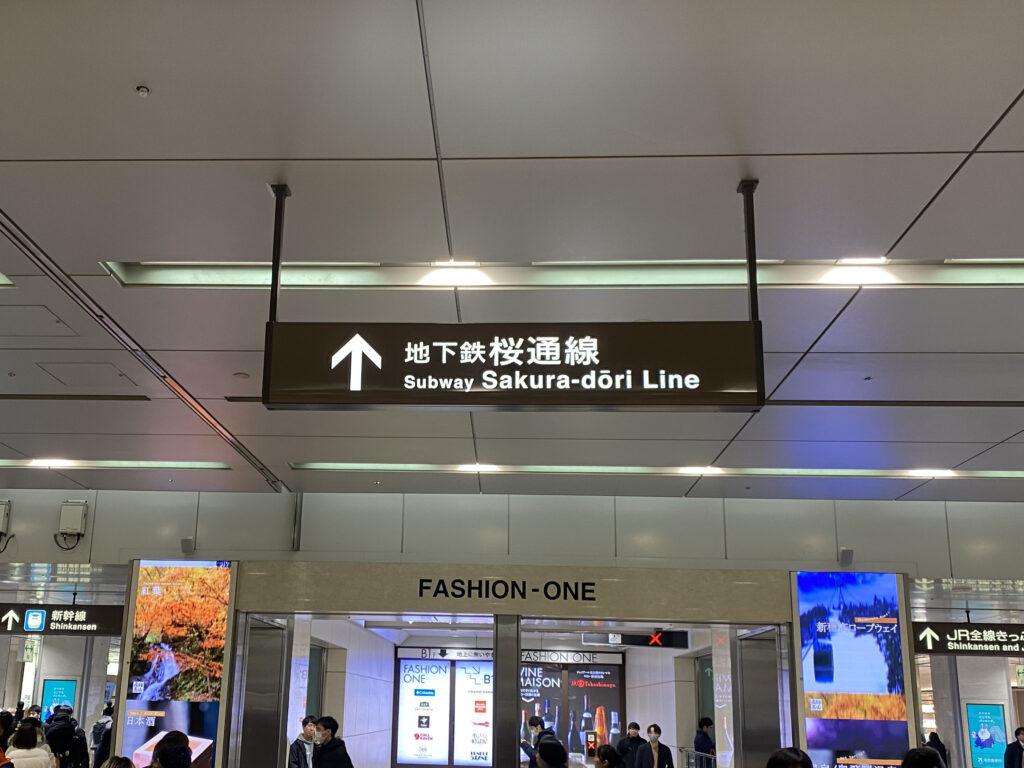
At Nagoya Station, the subway lines you can board are:


The Higashiyama Line is super useful for getting to central areas like Fushimi, Sakae and Osu (and for many tourist itineraries).
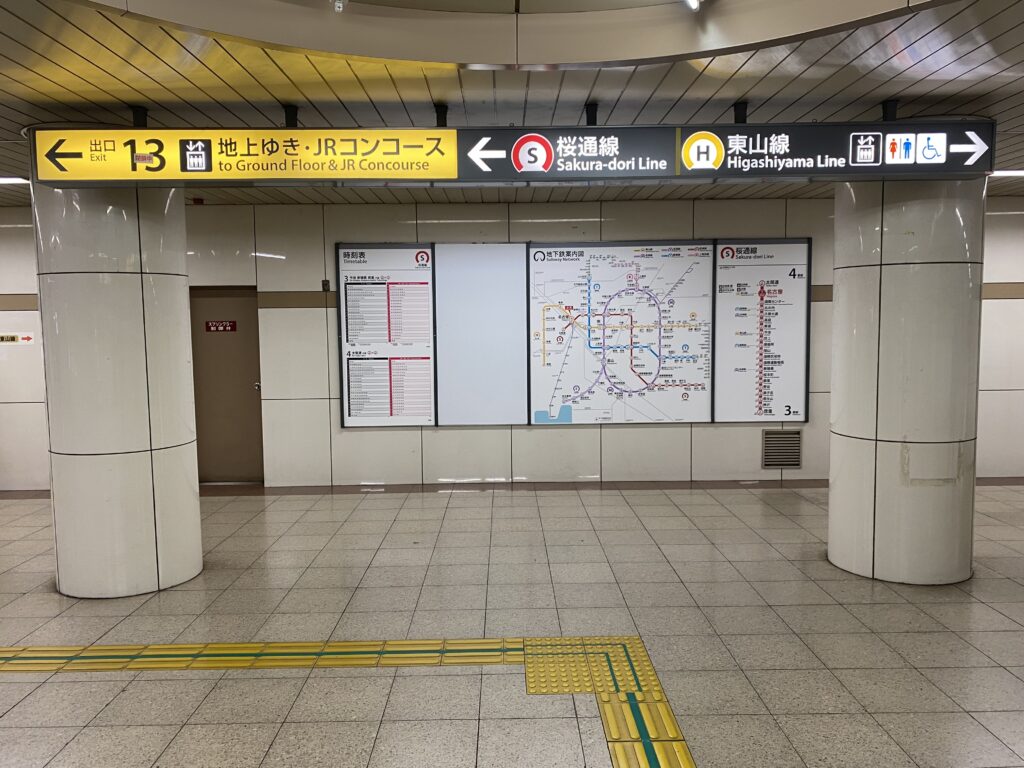
The Sakura-dōri Line is a good east–west option that also connects to major transfer stations, which is often less crowded than Higashiyama on some sections.
Article Contents
How to buy a paper ticket
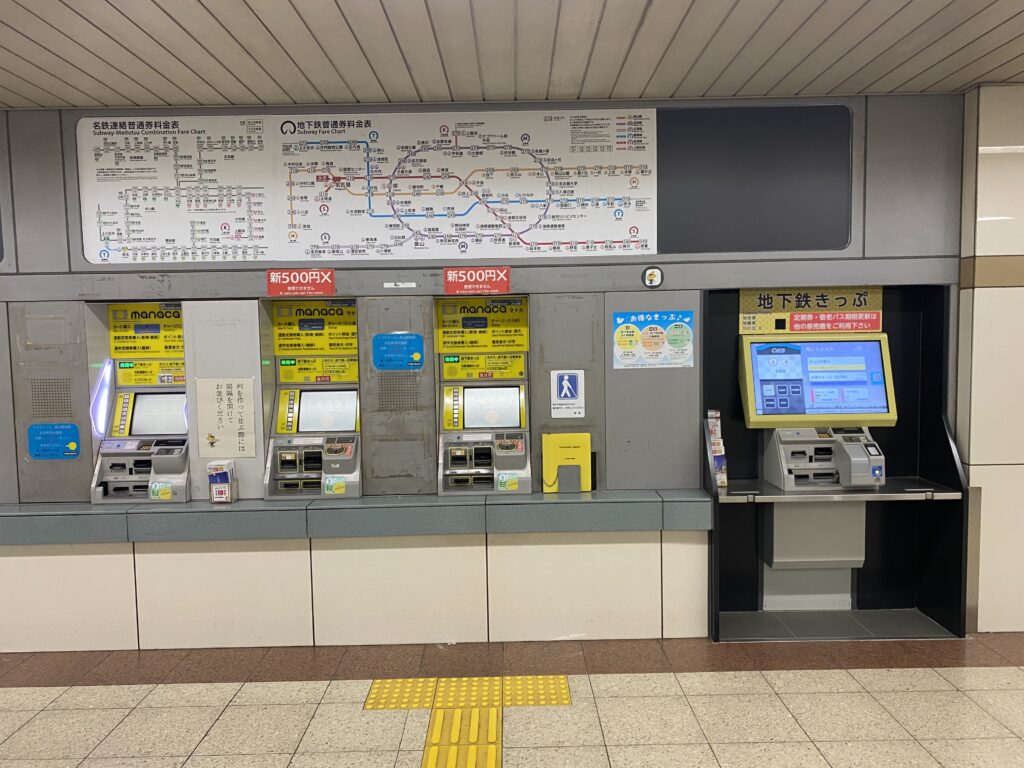
Nagoya Subway stations have ticket vending machines near the gates. The flow is:
- Look overhead for signs that say Subway (地下鉄).
- Follow signs toward the platform and ticket gates (改札).
- Purchase a ticket at the ticket vending machine.
On Nagoya’s subway, you typically buy a ticket by fare amount, not by selecting a destination. You check the fare using the station map/fare chart above the machines.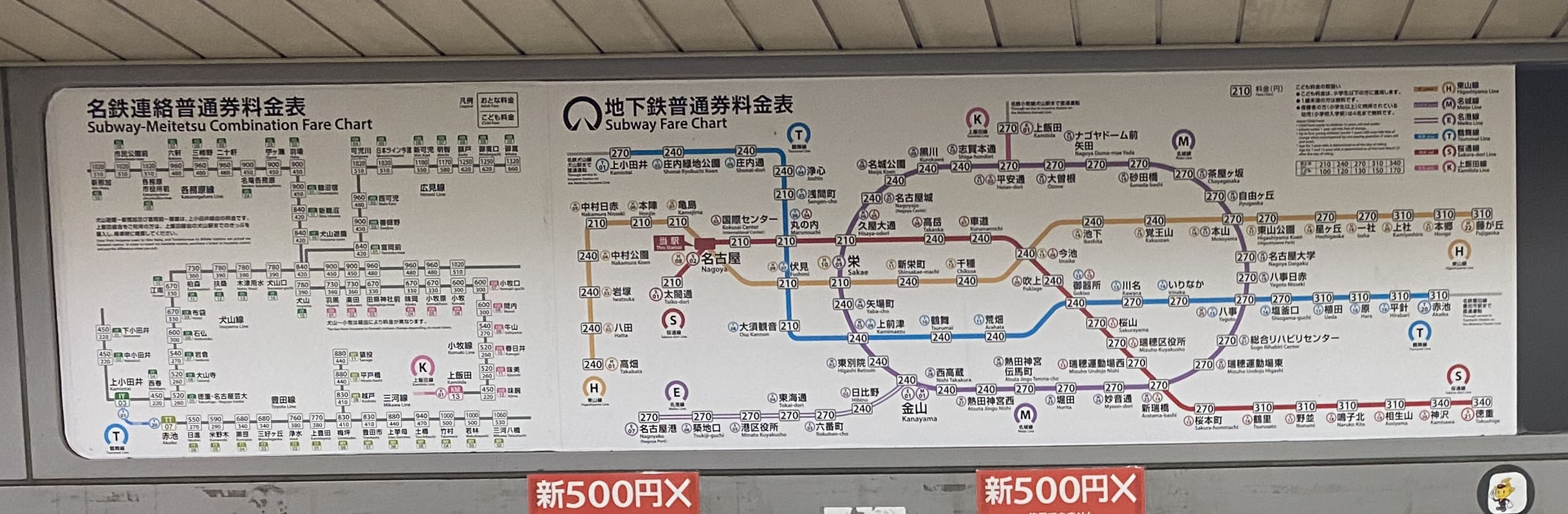
Find your destination station on the network map/fare chart near the machines and note the fare.
On the machine, choose English if needed (many machines support it).
Select the button for the fare amount, choose the number of tickets, insert cash, and collect your ticket + change. - Insert your ticket into the ticket gate and walk through.
Do not forget to collect it on the other side.
Once you reach the platform, it is easy to confirm that you are in the right place. Check the line color and letter, then look at the platform number and the terminal station name to make sure the train is heading in the correct direction. - Once you reach your destination, insert your ticket into the exit gate and pass through.
Regular tickets are typically kept by the gate at the exit, but some special tickets, such as certain day passes, are returned. Be sure to take them back.
If you change subway lines within the system, follow the “Transfer” signs and stay inside the paid area. There is no need to exit the gates.
If you traveled farther than your ticket allows, use a Fare Adjustment Machine near the gates before exiting.
How much does the Nagoya subway cost?
Fares on the Nagoya Subway are based on distance and divided into zones. For adults, one way fares range from ¥210 to ¥340, depending on how far you travel. Children aged 6 to 12 enjoy discounted fares, starting at ¥100 and going up to ¥170.
If you plan to use public transport frequently, Nagoya offers several good value passes. The Nagoya Subway 24 Hour Ticket costs ¥760 for adults and allows unlimited subway rides for 24 hours from your first gate entry. Another convenient option is the City Bus and Subway 1 Day Ticket, priced at ¥870 for adults, which lets you use both the subway and city buses all day.
For weekends, holidays, and selected special days, the Weekend Eco Ticket is a great budget friendly choice at ¥620 for adults, offering unlimited travel on eligible routes.
IC cards: the easiest option (MANACA and friends)
Instead of buying paper tickets each time, you can use MANACA, Nagoya’s main IC transport card. Simply tap the card at compatible ticket gates to enter and exit the subway. Many travelers already have an IC card, as major Japanese IC cards can be used across regions.
In addition to MANACA, other commonly used IC cards include Suica, PASMO, ICOCA, TOICA, SUGOCA, nimoca, and Kitaca. These cards are generally interchangeable and work on most trains, subways, and buses throughout Japan.
How to use IC cards at the gates
To enter the subway, look for a ticket gate marked with the IC card symbol. Hold your card flat against the sensor until you hear a beep and the gate opens. There is no need to remove the card from your wallet as long as it can be read.
When exiting, tap the card on the sensor again at the exit gate. The correct fare will be automatically deducted from your balance. If your balance is too low, the gate will close and display a message, and you can top up your card at a nearby fare adjustment or recharge machine before exiting.
Lines and example routes
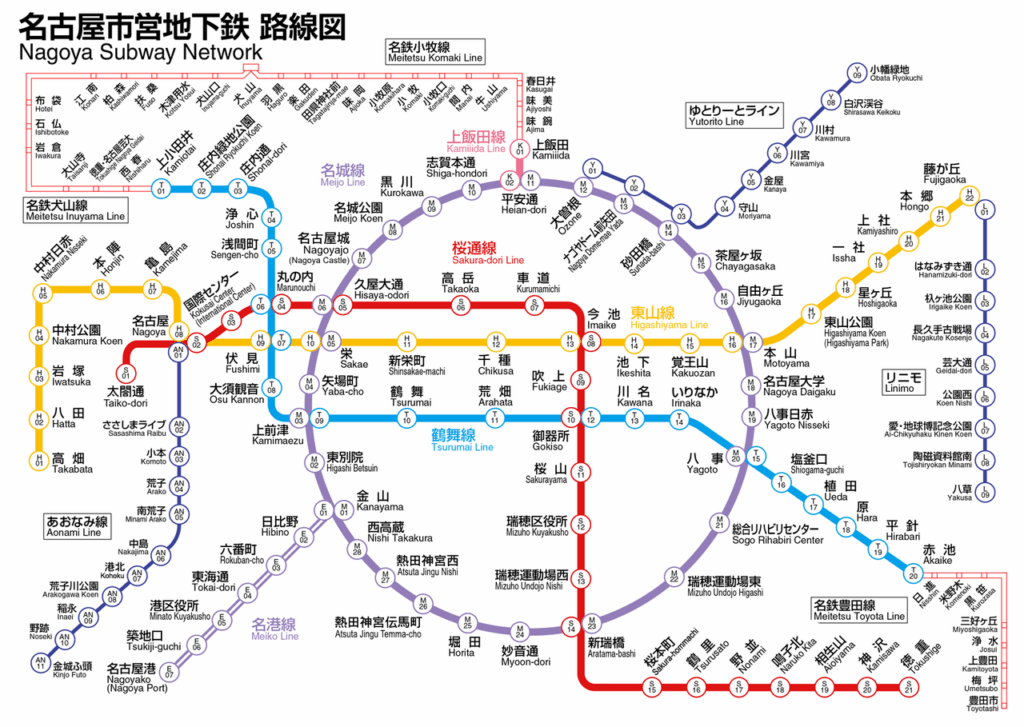
Higashiyama Line (Yellow / H)
The Higashiyama Line runs east–west through the heart of Nagoya, linking Nagoya Station with the city’s main downtown and cultural areas. It’s the most convenient, and most popular, subway line for tourists.
Key stops for visitors:
- Nagoya Station – the city’s main transportation hub
- Fushimi – museums, office area, and major transfer point
- Sakae – shopping district, Oasis 21, and TV Tower
Take this line if you’re heading to central Nagoya, planning to shop, or need to transfer to another subway line.
Sakura-dōri Line (Red / S)
The Sakuradori Line also runs east-west, slightly south of the Higashiyama Line. It’s often less crowded and works especially well as a transfer route across the city.
Key stops for visitors:
- Nagoya Station – the city’s main transportation hub
- Hisaya-odori – Hisaya-odori Park, Nagoya TV Tower, cafés, and transfer to the Meijo Line
- Marunouchi – a calm central business area with offices, hotels, and restaurants, within walking distance of Sakae and Nagoya Station
Use this line if you need an easy transfer to the Meijō Line.
Meijō Line (Purple / M)

The Meijo Line forms a loop around central Nagoya, much like Tokyo’s Yamanote Line. It’s ideal for moving between key districts without backtracking and for reaching many of the city’s major landmarks.
Key stops for visitors:
- Nagoya Castle – one of Nagoya’s most famous historical sites
- Sakae – entertainment, nightlife, and shopping
- Kanayama – major JR connections, restaurants, and nightlife
Take this line if you want to visit Nagoya Castle or travel easily between central Nagoya districts.
Tsurumai Line (Blue / T)

The Tsurumai Line runs north–south through some of Nagoya’s most character-filled neighborhoods, making it a great choice for culture, shopping, and green spaces.
Key stops for visitors:
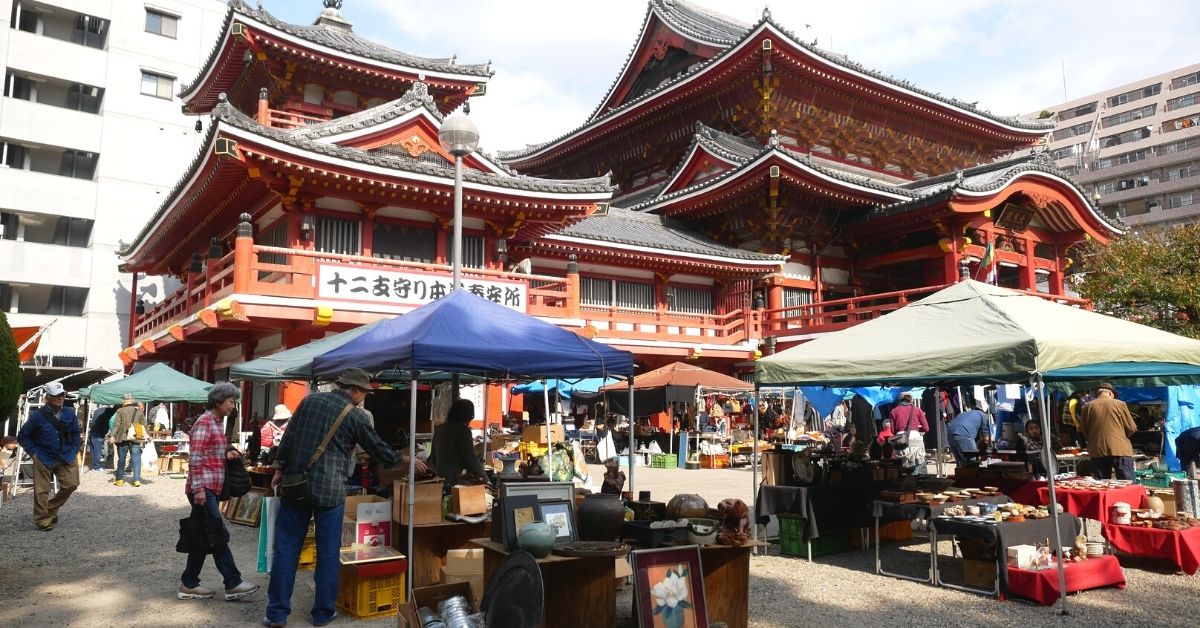
- Osu Kannon – historic temple and lively shopping streets
- Tsuruma Park – a popular spot for cherry blossoms in spring
- Nagoya City Science Museum – interactive exhibits and a planetarium
Take this line if you’re exploring Osu, visiting parks, or spending time at museums.
Meikō Line (Light Purple / E)

The Meiko Line connects central Nagoya with the port area, making it the simplest way to reach waterfront attractions.
Key stops for visitors:
- Nagoya Port Aquarium – one of Japan’s largest aquariums
- Nagoya Maritime Museum – interactive exhibits on ships, ports, and ocean trade
- Port of Nagoya – port-side walks, museums, and family-friendly attractions
Take this line if you’re visiting the aquarium or exploring Nagoya’s port area.
Kamiiida Line (Pink / K)

The Kamiiida Line is a very short route mainly used by local residents and has little direct sightseeing value.
Key stops for visitors:
- Heian Shrine – a quiet local shrine popular with residents
- Shiga Park – a relaxed neighborhood park, especially pleasant in spring
- Kamiiida – local shopping streets and easy transfer to the Meitetsu Komaki Line
Take this line if you’re staying nearby, want a break from tourist crowds, or need a transfer toward northern Nagoya.
Who to ask if you have problems
You have a few reliable options, even if you don’t speak Japanese:
A) Station staff / ticket office (best for immediate help)
If you’re stuck at a gate, can’t recharge, or bought the wrong ticket, station staff can help.
At major stations, staff are used to assisting non-Japanese speakers and may use simple English, gestures, or translation tools.
B) Transportation Bureau Service Center (Nagoya Station)
Nagoya Station has an official Transportation Bureau Service Center with set hours and a phone number, useful for ticket and pass questions. English support is limited, but staff are generally patient and accustomed to helping foreign visitors.
C) Help button/intercom at gates
If a gate won’t open or your card or ticket errors out, use the intercom or help button near the gates.
Even without Japanese, you can usually explain the situation by showing your ticket or IC card. There is often a small camera next to the intercom, and staff may ask you to show your ticket or card there. In many cases, they will then instruct you to use the fare adjustment machine near the gate.
Common mistakes (and how to fix them quickly)
Even locals make mistakes. Here’s how to recover calmly.
❌ Bought the wrong fare
What happens: The exit gate won’t open.
Fix: Use the Fare Adjustment Machine near the exit, or go to the staff window; this is very normal.
❌ Went the wrong direction
What happens: You realize it after one stop.
Fix: Get off at the next station, cross to the opposite platform (no extra charge).
❌ Entered through the wrong company’s gate with your IC card
What happens: Nagoya Station has JR, Meitetsu, Kintetsu, and Subway gates close together.
Fix: Talk to the staff immediately; they will help you exit correctly.
❌ The IC card didn’t work at the gate
What happens: The gate does not open when you tap your IC card.
Fix: Check your balance at a machine, or press the intercom/help button at the gate for assistance.
❌ Confused by transfers
What happens: It’s unclear whether you should stay inside the paid area or exit the gates when changing lines.
Fix: Follow signs that say 乗り換え (Transfer) and stay inside the gates unless the signs explicitly tell you to exit.
❌ Worried about language
What happens: You’re unsure how to buy tickets or ask for help because you don’t speak Japanese.
Fix: Ticket machines often have English menus, station staff are used to helping visitors, and showing your destination on Google Maps is perfectly acceptable.
You’ll be fine on the subway
You don’t need to memorize everything to get around.
If you remember just three simple things, you’ll be fine:
- Line color and direction matter more than station names.
- Fare problems are easy to fix at the exit gates.
- Station staff help visitors every day, don’t hesitate to ask.
Public transit in Japan is designed to recover from mistakes.
If something goes wrong, there’s almost always a clear, simple way to fix it.
You can find more information on the Transportation Bureau, City of Nagoya website.
If you are looking for a complete guide of the Nagoya transportantion you can read this other blog article.